




Moskito Island: A Private Estate in a Layered Seascape
Moskito Island brings an estate-centered expression of privacy to the British Virgin Islands. Its appeal lies in substantial individual residences set within a small island landscape, where the shape of the shore and the position of a headland can give each property a distinct identity. The Branson Beach Estate, represented in LaCure's collection, makes this relationship especially clear: separate villas occupy different positions around the same coastal setting. The experience is less about a single imposing façade than about a sequence of residential spaces, each establishing its own connection with the island and the surrounding water.
The island's wider context is the North Sound area, a setting in which neighboring landforms remain an important part of the view. Water creates separation, while the outlines of other islands give the horizon depth and direction. This layered composition makes the outlook feel specific rather than interchangeable with any distant sea panorama. From a residence, the eye can move between the immediate shoreline, the open channel, and the more distant terrain. For guests who appreciate a landscape with visual structure, that relationship gives Moskito Island an especially engaging residential setting.
The Branson Beach Estate
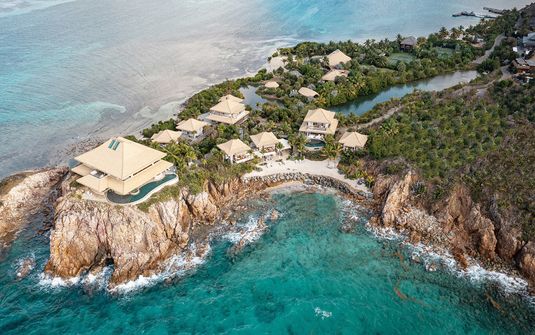
The Branson Beach Estate occupies the island's northeastern tip and brings three standalone villas into one architectural ensemble. Elevated wooden connections link the buildings without erasing their individual identities. This arrangement has a meaningful effect on the character of a private stay: the estate can feel coherent at a group scale while retaining smaller, more personal domestic settings. The shoreline, planting, and changes in level help distinguish one part of the property from another. Rather than concentrating every room around a single central volume, the composition gives the estate several different points of focus.
Headland House
Headland House establishes a strong relationship with the site's elevated outcrop. Its position at the heart of the estate gives the residence a different presence from a building tucked closer to the shore. The prospect is broad, and the architecture responds to that openness with spaces directed outward toward the sea. Within a multi-villa arrangement, a house in this position can provide a memorable common reference point without needing to dominate every guest's private surroundings. The headland gives the building its identity, allowing the natural prominence of the site to carry much of the visual impact.
Beach Villa
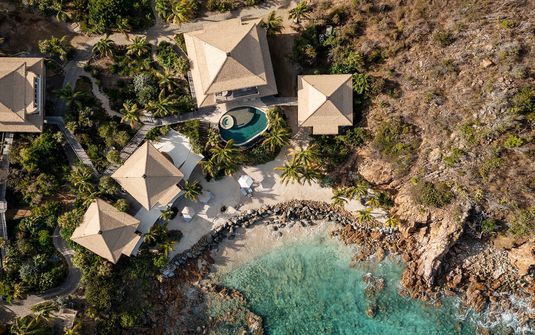
Beach Villa sits just above a sandy shore, creating a more immediate coastal relationship. Here the foreground matters as much as the horizon: the texture and curve of the beach become part of the residence's daily outlook. The scale feels more intimate than a high promontory, with a closer visual connection between the building and the water's edge. Its placement also changes the emotional register of the estate. Where an elevated house can feel expansive and observant, a shoreline residence can feel more sheltered and closely held by the contours immediately around it.
Mangrove Villa
Mangrove Villa introduces a greener setting and an easterly outlook toward Necker Island and Virgin Gorda. The presence of mangrove trees gives this part of the estate a different frame, with vegetation helping to mediate between building and seascape. The view has named landforms rather than a purely abstract horizon, and that specificity makes orientation part of the room's character. In the wider composition, this villa adds an important contrast: a place where planting and the surrounding terrain contribute more visibly to the atmosphere, alongside the estate's more exposed headland and shoreline positions.
Balinese Influence and Island Proportions
The estate's Balinese-inspired architecture introduces a pavilion sensibility suited to a residence made up of several buildings. Roof forms and timber connections create a recognizable visual rhythm, while the separation between volumes keeps the overall composition from reading as one continuous block. The effect is particularly appealing on a site with changes in elevation, where each building can meet the ground on its own terms. Architectural identity comes from the relationship between the parts: the way a roof sits against the landscape, a connection spans between houses, or a terrace opens toward a distinct portion of the view.
Connections That Preserve Individual Space
In a multi-building estate, the spaces between houses are as consequential as the houses themselves. A connection can provide continuity for the party while preserving a useful threshold around a private bedroom or living area. The distinction is subtle but important: guests should be able to recognize when they are entering a shared setting and when they are approaching someone's more personal territory. The Branson Beach Estate's distributed arrangement gives that question a physical form. It supports a style of stay in which different parts of the group can remain connected without feeling constantly gathered in one interior.
An Estate for More Than One Household
For families or close friends occupying a substantial property together, a grouping of villas creates opportunities that a single large house may not. Each household can establish a familiar base while the wider estate provides a shared setting. This can be particularly valuable when the party includes several generations, couples with different preferences for quiet, or guests who simply appreciate a little domestic independence. The most suitable arrangement is one in which the distribution of rooms reflects the group naturally, with personal space treated as an integral part of the experience rather than a secondary consideration.
Privacy at Several Scales
Moskito Island should be understood as a private island community containing individual estates, rather than as one interchangeable residence. Within an estate, privacy becomes more specific again: a bedroom's position, the outlook from a terrace, and the relationship between neighboring villas all influence how secluded a space feels. An open sea view and a discreet personal setting are different qualities, even when a property offers both. The island's appeal is strongest when these layers work together, giving guests a recognizable boundary around their own surroundings while retaining the breadth and visual openness of the larger seascape.
A Distinctive Residential Address
Within the Caribbean, Moskito Island has a character defined by architectural individuality and the scale of its estates. The Branson Beach Estate illustrates that character through three different coastal positions held together by a coherent design language. It offers more than a succession of generous rooms: the headland, beach, and planted surroundings give the property a range of atmospheres. For a private party, that variety can make a longer stay feel more nuanced, with different settings supporting different degrees of connection to the rest of the group and to the island itself.
The enduring attraction of Moskito Island is the opportunity to inhabit a residence with a clearly expressed relationship to its site. A house above the water, a quieter villa near planting, and a building close to the shore each reveal the same island differently. Together, they give an estate depth without requiring architectural excess. For guests who value both personal territory and a generous shared setting, this is a persuasive form of island luxury: distinctive buildings, a richly composed coastal landscape, and enough separation for the stay to feel private at the level of the individual as well as the group.


