




Necker Island: A Distinctive Private-Island Home
Necker Island occupies a singular place within the British Virgin Islands, combining the intimacy of a private island with a residential landscape that has several distinct centers. The elevated Great House provides a recognizable architectural presence, while separate Balinese-style houses introduce smaller, more personal settings across the island. This is a place whose character depends on contrast: a broad panorama from high ground, the closer enclosure of planting, and the individual scale of a bedroom terrace. The island feels coherent without every part of it offering the same outlook or atmosphere.
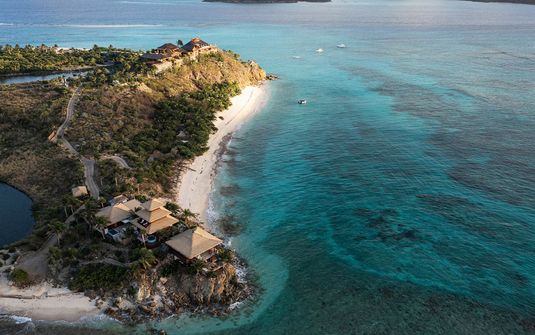
The surrounding water establishes a clear boundary, but the view reaches beyond the island itself. Neighboring landforms give the seascape depth, placing Necker within a wider archipelago rather than leaving it visually detached from its setting. From the highest positions, the relationship between open water and distant shorelines becomes especially apparent. Lower down, the island's own contours and vegetation take a greater role in the foreground. That movement between a large external prospect and a more contained local setting gives the residential environment a sense of variety that remains compelling throughout a stay.
The Great House and the Wider Island
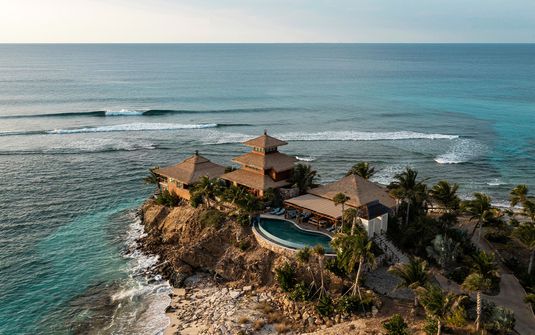
The Great House stands at the island's highest point, giving its Balinese-inspired architecture an unusually expansive setting. Its prominence makes it a natural reference within the residential composition, a place where the scale of the island can be understood through the surrounding panorama. The house offers a different experience from accommodation closer to the terrain: the outlook is broader, the sense of elevation more pronounced, and the relationship with the horizon more immediate. For guests who value a substantial shared residence, this position contributes as much to the atmosphere as the interior proportions of the building.
Architecture With a Recognizable Identity
Balinese influence gives Necker a visual language that distinguishes it from more anonymous coastal development. Pitched roof forms, timber elements, and pavilion-like buildings create a rhythm across the site rather than a single continuous frontage. The architecture has enough character to register in its own right, yet its separated volumes also allow the landscape to remain visible between buildings. That balance is important on a small island. A residence can feel substantial without making every outlook architectural, and individual houses can retain a recognizable identity while belonging to a larger residential setting.
The relationship between the Great House and the separate Bali Houses creates two complementary scales of accommodation. One concentrates rooms within a prominent shared building; the other distributes personal retreats more widely across the island. Neither arrangement is inherently more private in every respect. A guest may value proximity to the principal living spaces, while another prefers the threshold created by a separate house. Understanding that difference makes it possible to choose accommodation around the character of the party, allowing shared time and individual withdrawal to coexist without forcing everyone into the same domestic pattern.
Smaller Residential Groupings
Bali Lo introduces a grouping near the island's center, with separate houses forming a more intimate residential ensemble. A cluster of buildings has a different atmosphere from a corridor of rooms: there is a clearer sense of moving between personal territory and a shared setting. The surrounding vegetation also becomes part of the composition, softening the edges between one house and another. For guests who prefer a more contained environment within the wider island, this type of arrangement offers a useful intermediate scale, larger than an individual suite but more personal than the principal house.
Shared Space With a Defined Identity
The Bali Hi grouping and Temple House illustrate how smaller shared settings can develop their own identity within the island. A common lounge or an outdoor space belonging to a particular cluster can create an informal center for a few guests, while the wider property remains available as the larger frame. The distinction matters for an extended party: several people can settle into a familiar corner without requiring the whole group to gather. In this way, Necker's distributed architecture supports more than one social scale, with personal rooms, smaller residential groupings, and the island's principal shared spaces each serving a different purpose.
Individual terraces add another layer to that arrangement. A terrace attached to a room provides a setting in which the surrounding landscape can be enjoyed within a more personal boundary. Its character depends on the relationship between the room, the edge of the building, and the view beyond. An expansive outlook may make the space feel open and outward-facing, while planting closer to the terrace can create a more enclosed atmosphere. These distinctions are more useful than a generalized description of sea views, because they influence how a guest actually inhabits the room.
Space for Families and Private Parties
For a multigenerational family, the distribution of accommodation can be one of Necker's strongest attributes. Members of the same party may prefer different degrees of proximity: some want to remain close to a common living area, while others appreciate a separate building and a quieter personal setting. The island's combination of a large house and smaller residential groups allows those preferences to be considered together. The aim is a coherent arrangement in which each household feels comfortably placed, rather than a simple allocation of bedrooms based only on the size of the overall party.
A Nuanced Sense of Seclusion
The privacy of an island setting is different from the privacy of an individual suite. Water defines the outer boundary; building placement, vegetation, and the arrangement of terraces define the smaller boundaries within it. A room may feel removed because it belongs to a separate house, or because its outlook is directed away from shared spaces. Those are distinct qualities, and each contributes something to the experience. Necker's most persuasive form of seclusion is therefore layered: the contained geography of the island combined with carefully understood personal spaces inside a broader residential environment.
Character Beyond the Panorama
Necker's place in the Caribbean rests on a recognizable architectural personality as much as on its sea views. The contrast between a prominent hilltop house and smaller buildings gives the island a domestic character that would be difficult to reproduce in a conventional hotel layout. A private stay gains depth from these changes of scale, from the wider perspective of a principal shared room to the more immediate setting of a terrace or a quieter bedroom grouping. The result is an environment with several moods, held together by the continuity of the island landscape and its distinctive design vocabulary.
The enduring attraction is the possibility of inhabiting the island as a collection of connected personal places. The Great House establishes a sense of occasion, the separate residences create room for independence, and the surrounding seascape gives every part a larger context. When the accommodation is matched thoughtfully to the party, those differences become the basis of a comfortable and generous stay. Necker Island offers a private residential world with a clear identity, where the architecture, the distribution of space, and the varied relationship with the landscape all contribute to the experience of being there.


