




Buck Island: An Intimate Private-Island Residence
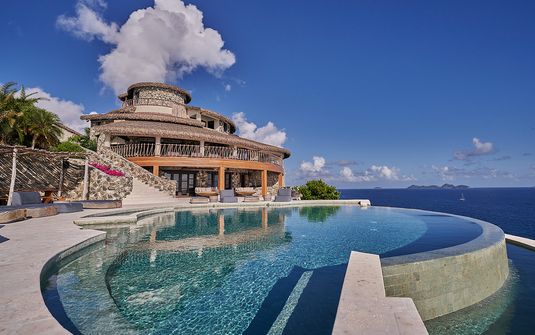
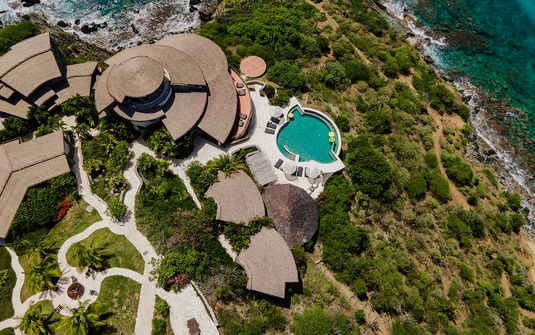
Buck Island has a distinct identity within the British Virgin Islands: a small island where the residential setting is distributed across a landscape of elevated ground, planted spaces, and water-facing edges. The Aerial gives that setting a recognizable architectural character through a collection of separate houses and individually designed rooms. The scale is intimate enough for the island to feel like a coherent place, yet varied enough for different parts of a private party to establish their own surroundings. The result is a stay defined by the relationship between a shared island environment and the quieter territory of an individual room.
The surrounding seascape gives Buck Island its wider context. This is a setting within an archipelago, where the horizon can include other islands rather than an uninterrupted band of open water. That layered perspective gives distance a tangible form: nearby slopes and shorelines sit against more remote silhouettes, and the view changes with the position of the observer. From an elevated deck, the island reads as part of a larger composition; closer to the shore, the relationship with the water becomes more immediate. Both perspectives contribute to the sense of place.
A Collection of Houses With Individual Character
The accommodation at The Aerial is conceived as a collection rather than a repeated room type. Unity House, Faith House, Serenity House, villas, and distinctive teepee-style accommodation contribute different architectural experiences within the island setting. This diversity matters to a group whose members have different preferences for outlook, enclosure, and proximity to shared spaces. A room with a loft has a different spatial character from one that opens directly onto a deck, just as a more elevated position changes the relationship with neighboring buildings. The island's residential appeal depends on these distinctions being understood individually.
Natural Materials and Crafted Detail
Timber is especially important to the visual language of Buck Island's interiors. Carved doors, custom furniture, and individually made pieces give the accommodation a tactile quality that goes beyond a neutral coastal palette. The craftsmanship introduces pattern and depth without requiring every surface to compete for attention. In a room that opens toward a bright seascape, the warmth of wood can provide a useful counterpoint, bringing the eye back to a more intimate scale. These details make the buildings feel inhabited and particular, rather than simply arranged around an impressive view.
The interiors draw on natural materials while allowing individual rooms their own expression. A distinctive bed, an unexpected ceiling profile, or a more open relationship with an adjoining deck can change the entire mood of a sleeping space. This variety is part of the island's character, but it also means that suites should be considered on their own terms. A private party may appreciate a common design sensibility without expecting every guest to occupy an identical room. The strongest arrangement gives each person a satisfying personal setting while retaining a coherent atmosphere across the houses.
Rooms That Extend Toward the Water
Private balconies and decks are central to many of the rooms at The Aerial, creating a transition between the more enclosed interior and the larger island landscape. These spaces bring the outlook close to the room without making every moment part of a communal setting. Their value lies in their proportions and placement: a deck that feels naturally connected to the bedroom can become a genuine extension of its private territory. The relationship to neighboring accommodation still matters, especially where several rooms share a house, and should be understood alongside the view.
Open-Air and Enclosed Spaces
Some accommodation makes a more direct architectural connection with the outdoors through private outdoor showers or more open structures. The teepee-style rooms are a particularly distinctive example, with a different degree of enclosure from conventional bedrooms. These are meaningful differences in the experience of a stay, not interchangeable expressions of the same suite. Guests who favor a fully enclosed room may choose differently from those drawn to a more immediate connection with the landscape. Buck Island's variety allows the accommodation itself to become part of the character of the visit.
The view also has an interior dimension. An opening positioned beside a bed can give the room a quiet focal point, while a deck reached through the main seating area makes the outlook part of a more sociable space. The placement of furniture determines whether the room feels directed toward the sea or organized around its own crafted details. These smaller compositional decisions are particularly noticeable on an island where the external setting is so present. A considered room balances the scale of the horizon with the comfort of a place that still feels personal.
Sharing the Island Without Sharing Every Space
For a family or a close group, the distribution of accommodation among separate houses creates a different dynamic from occupying a single large villa. Guests can remain part of the same island setting while having a more distinct domestic base. That separation can be especially valuable when different generations prefer different degrees of quiet or when couples want an individual retreat within a shared stay. The arrangement of rooms within each house remains relevant: separate buildings create one layer of privacy, while the relationship between neighboring bedrooms creates another. Both should suit the composition of the party.
The Meaning of Private-Island Scale
A small island provides a recognizable boundary around the residential environment, but privacy within that boundary still depends on the arrangement of buildings and spaces. A deck may be outward-facing and visually open, while a room elsewhere feels more enclosed by planting or the shape of the site. The distinction between personal and shared territory gives the stay its rhythm. Rather than relying on a generalized promise of absolute seclusion, Buck Island is best appreciated through this more nuanced balance: a contained setting, several residential groupings, and individual places to withdraw within them.
An Understated Expression of Island Luxury
Buck Island's place in the Caribbean is shaped by its intimacy and its preference for natural texture over imposing architectural scale. The character comes from a collection of details: timber against pale interiors, a private deck extending a bedroom, a separate house taking its place within the island's contours. Together they create a residential environment that feels closely connected to its surroundings. For guests accustomed to larger estates, the distinction is the sense of a whole island setting held within a comparatively compact and personal frame, with different spaces contributing to a shared atmosphere.
The most satisfying stay on Buck Island begins with accommodation that fits the people who will inhabit it. A carefully composed allocation of houses and rooms allows the island's variety to work to the group's advantage, bringing together different outlooks, interior characters, and degrees of retreat. The surrounding water provides continuity, while the buildings give each guest a more individual point of connection. Buck Island's enduring appeal lies in that combination of coherence and difference: one intimate island, a distinctive collection of residences, and enough personal space for the stay to feel comfortably one's own.


