




Chamonix: A Private Address Beneath Mont Blanc
Chamonix has a physical presence that distinguishes it within the French Alps. The Mont Blanc massif rises above an inhabited valley, giving private residences a setting that feels both monumental and lived in. This is a mountain address with a strong sense of place: steep rock faces, wooded lower slopes and the long alignment of the valley remain visible reminders that the architecture occupies a landscape far larger than itself.
Within France, few residential settings offer quite this relationship between a substantial mountain community and such emphatic natural scale. A chalet here can provide domestic warmth without diminishing the intensity of the outlook. The appeal lies in that coexistence, particularly for guests who want the interior to feel personal and settled while the surrounding terrain retains its uncompromising character. The house becomes a place of shelter rather than an attempt to compete with the scenery.
The Valley as a Residential Landscape
Chamonix’s elongated geography creates meaningful differences between individual addresses. Some homes belong to a more closely settled village environment, while others occupy quieter margins with trees and open ground between buildings. The impression from the principal rooms can change accordingly, from a layered view over neighboring roofs to a more direct encounter with the mountain slopes. These distinctions give the valley a range of residential atmospheres that a single panoramic photograph cannot fully communicate.
The direction of the outlook also shapes the architectural experience. A broad mountain view can make a communal room feel outward-looking and expansive, whereas a more enclosed wooded setting introduces intimacy and texture. A house with different perspectives across its rooms offers a particularly rich sequence of interiors. The landscape then becomes part of everyday domestic life rather than a single dramatic feature reserved for the main terrace or the largest reception space.
A Framed View Rather Than a Continuous Spectacle
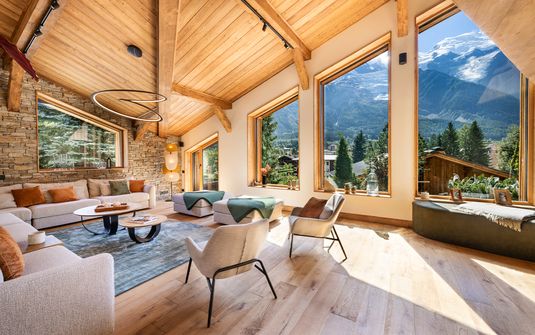
The most persuasive chalet design does not require every wall to disappear into glass. A deep window, an upper-level balcony or a carefully positioned opening can give a particular mountain profile greater visual clarity. Solid walls and timber surfaces provide balance, allowing the eye to rest within the interior. This alternation between enclosure and openness is especially effective in Chamonix, where the scale of the surrounding peaks already supplies more than enough visual drama.
The immediate grounds contribute a different, more human scale. Established planting, a protected terrace or a stretch of open lawn can soften the transition from house to mountain landscape. Their value lies in how naturally they connect with the living areas and how much discretion they provide from surrounding properties. A residence need not occupy an enormous plot to feel private, but its boundaries and neighboring sightlines should support the atmosphere established by the architecture.
A Chalet with Warmth and Substance
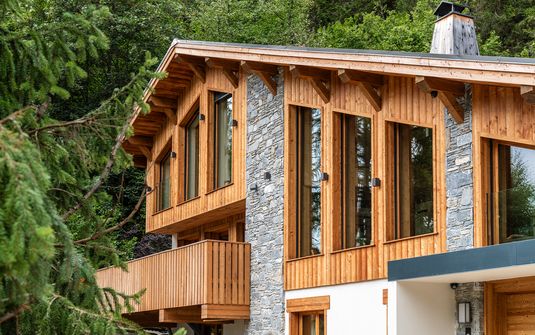
Timber and stone remain convincing materials in this setting because they give the interior a sense of weight and continuity. Exposed structure, generous roof forms and tactile finishes can coexist with contemporary glazing and restrained furnishings. The result is most successful when the home retains the character of an alpine residence rather than borrowing an unrelated urban aesthetic. Warmth comes from proportion, texture and the way rooms are furnished, not simply from the quantity of decorative wood.
A large communal room can form the center of the house, but quieter secondary rooms are equally important during an extended stay. A library-like corner, a separate lounge or an upper-level retreat gives the household a choice of atmosphere. These smaller spaces allow different conversations and periods of solitude to coexist. They also give a substantial chalet a more varied domestic character, preventing the experience from revolving entirely around one impressive open volume.
Discretion Across Different Levels
Mountain houses often use changes in level to work with their sites. This can create useful separation between reception spaces and bedroom suites, although the internal circulation should remain intuitive. For a family, the proximity of selected bedrooms may matter more than complete independence; for couples, equally comfortable suites can be the priority. The most suitable arrangement is the one that makes the household feel at ease throughout the residence, not merely at the moment of arrival.
Privacy extends beyond the bedroom door. The position of staircases, the relationship between balconies and neighboring buildings, and the visibility of exterior spaces all influence how comfortably a group can inhabit the property. Where service is arranged, practical ancillary areas help maintain separation between household support and private rooms. These quieter aspects of planning are often what allow an architecturally striking chalet to function as a genuinely comfortable home over a longer period.
A Distinctive Mountain Home
Chamonix suits guests who appreciate a strong landscape identity and a residence that offers a deliberate counterpoint to it. The rooms need not be theatrical to feel exceptional when their outlooks, proportions and materials are carefully resolved. A well-chosen house allows the mountains to remain present while preserving the intimate routines of a private stay. That balance gives the destination a character that is more substantial than a generalized image of alpine indulgence.
The lasting impression is often a relationship between scales: the detail of timber close to hand, the depth of a comfortable room and the extraordinary height beyond the window. Chamonix brings these elements together with unusual clarity. For a discerning household, a private chalet offers an independent and composed way to inhabit the valley, with architecture that provides warmth and discretion while remaining unmistakably connected to the landscape beneath Mont Blanc.


