




Madrid: A Private City Residence With Historical Character
Madrid offers a substantial urban expression of private living within Spain, where distinguished apartment buildings can hold interiors with generous proportions and a strong sense of domestic identity. The character of a stay often emerges behind the street façade: a considered entrance, a sequence of well-defined rooms, and private accommodation that allows a household to settle comfortably within the city. The most compelling addresses feel complete in their own right, with enough architectural substance and personal space for the residence to become a meaningful part of the experience rather than simply its urban base.
The city's residential fabric supports a range of outlooks and degrees of enclosure. A room facing a street participates in the rhythm of neighboring façades, while an interior position may have a more contained relationship with the building around it. Upper floors can introduce another perspective across roofs without losing the sense of a distinctly urban setting. These differences matter within a private home, giving rooms individual atmospheres and allowing shared spaces to remain outward-facing while quieter parts of the residence establish a more personal scale.
Las Cortes and the Character of an Established Building
Las Cortes, represented in LaCure's Madrid collection, occupies an early twentieth-century building in the Cortes neighborhood. The apartment's appeal comes from the combination of historical proportions and contemporary domestic comfort, with the surrounding architecture providing a clear local context. A residence within an established building has a different atmosphere from a detached house: its privacy is created through thresholds and internal planning, while the city remains visible in the outlook and the relationship between neighboring façades. This gives the stay a sense of belonging to Madrid's built fabric.
Height, Windows, and Balconies
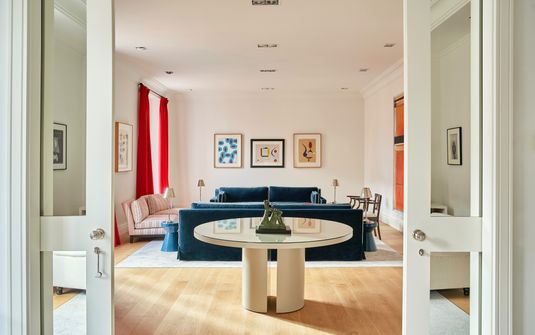
Three-meter ceilings give Las Cortes a generous vertical scale, while large windows and balconies establish a direct visual relationship with the exterior. These are architectural qualities that influence the character of the whole interior, not merely decorative advantages. Taller rooms can accommodate substantial furnishings without feeling crowded, and a well-proportioned opening brings depth to a wall. The balconies provide a threshold at the façade, adding a more immediate urban perspective alongside the comfort of the enclosed rooms. Together, these elements give the apartment a recognizable residential presence.
The quality of a generous room also depends on how its scale is handled. Seating groups should feel proportionate to the people using them, allowing conversation and quiet occupation without turning the space into a ceremonial salon. Clear circulation leaves the principal arrangement intact, while a view through an adjoining doorway can add depth without requiring an entirely open plan. In a historic apartment, such decisions allow the building's original proportions to remain expressive while making them practical for the household. The result feels composed through everyday use rather than solely through presentation.
Art and Interior Identity
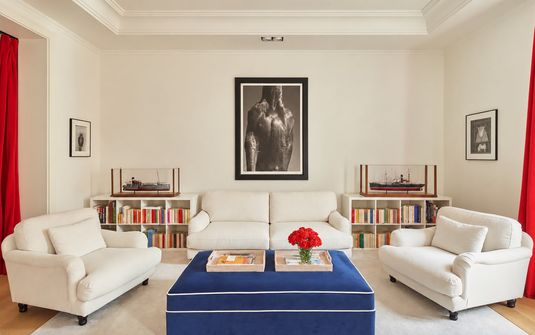
A curated collection of Spanish artwork gives Las Cortes an individual interior character. Art can establish a connection with place at a more personal scale than a broad architectural reference, bringing color, texture, and a distinct point of view into the rooms. Its role is strongest when it belongs naturally to the furnishing scheme and the proportions of the building. The residence then feels like a considered home rather than a sequence of neutral spaces. This sense of individuality is especially valuable in an urban stay, where the interior provides the household's familiar center within the larger city.
More Than One Shared Room
The apartment's principal living room is complemented by an independent television room, creating two different communal settings. A separate secondary room gives a private party greater flexibility than one continuous interior, allowing different preferences to coexist without requiring anyone to withdraw to a bedroom. The distinction also makes the apartment feel more domestic. A larger shared space can retain its own atmosphere while a quieter room offers another place to settle, giving the home depth through the relationship between its rooms rather than through sheer floor area alone.
Such variety is particularly useful during a longer stay. The household develops familiar patterns around the residence, with some spaces becoming more collective and others more personal. A well-resolved apartment supports those differences without making movement through the home feel complicated. Doors, corridors, and the placement of furniture help establish a clear sequence, preserving the identity of each room while keeping the residence coherent as a whole. The quality lies in the ease of that arrangement, allowing the architecture to support the people occupying it without demanding their constant attention.
Private Accommodation With a Clear Structure
Las Cortes includes four bedrooms with their own bathrooms, comprising three double rooms and one single room. That distinction is important to the character of the accommodation: the apartment offers different room types rather than four identical suites. A household can use that variety thoughtfully, matching the personal spaces to the composition of the party. Individual bathrooms provide a clear layer of independence, while the shared rooms retain their role as the home's common center. The arrangement brings the scale of the apartment back to the practical comfort of the people staying together.
Discretion in a Shared Urban Building
Privacy within a city apartment is experienced through the sequence from the building entrance to the private rooms. A clear threshold around the residence establishes one boundary, while the separation between bedrooms and common spaces creates another. The position of windows and balconies also affects how a particular room relates to its surroundings. These details deserve more attention than a generalized description of an exclusive address. A comfortable home makes personal territory intuitive, allowing guests to remain part of one household while retaining a quiet space that feels distinctly their own.
A Madrid Home With Its Own Perspective
Within Europe, Madrid offers an urban residential atmosphere with considerable architectural weight and a clear capacity for personal interiors. A historic apartment can express the city through ceiling height, window proportions, artwork, and the rhythm of rooms behind its façade. The experience is strongest when those elements work together, giving the residence a coherent identity rather than relying on one exceptional feature. For guests who value a substantial home in an established city setting, this combination provides a persuasive balance of local character, private comfort, and spatial generosity.
A memorable Madrid stay becomes grounded in the particular details of the residence: a favorite room, an artwork that gives an interior its focus, or the outlook from a balcony above the street. These qualities grow more familiar without losing their distinction. Las Cortes illustrates the appeal of a private apartment whose historical setting and domestic arrangement remain clearly connected, giving a household an individual home within the city. The enduring luxury lies in that completeness, with architecture and personal space carrying the experience from the principal salon to the quietest bedroom.


