




Marche: Private Country Houses Between the Apennines and the Adriatic
Marche has a distinctive eastward geography: upland contours give way to cultivated hills, compact settlements and, eventually, the Adriatic. This part of Italy offers a country-house setting in which the landscape is rarely reduced to one dramatic landmark. Its character comes from successive layers of land and architecture, with a private residence providing a settled center among fields, wooded folds and villages that remain clearly legible on the surrounding slopes.
The residential experience can be expansive without feeling remote. A restored farmhouse may occupy its own rise, while a more formal villa establishes an ordered relationship with gardens and an entrance approach. Elsewhere, a house belongs to a denser settlement, concentrating its private world behind masonry walls or within a rear courtyard. These different settings give the region range, allowing the household to choose an atmosphere rooted in the actual building and land rather than a generalized image of rural Italian luxury.
The Rhythm of the Hills
Much of Marche’s visual identity lies in repetition without uniformity. Cultivated slopes, tree lines and clustered buildings follow the contours, giving the view a human scale even when it extends a considerable distance. From a country residence, the foreground may be a lawn or orchard, with neighboring fields and a distant settlement beyond. That depth makes several outlooks valuable: the house can reveal different aspects of the same landscape instead of directing every room towards a single dominant panorama.
The relationship with the coast changes from one property to another. A more easterly outlook may include a distant marine horizon, while an inland residence can feel entirely absorbed in the hills and the approaches to the Apennines. Neither needs to imitate the other. The most persuasive address uses its particular position honestly, allowing a sheltered garden, an agricultural view or a broader horizon to establish the atmosphere that the household actually experiences from its rooms and grounds.
A Building Set Within Cultivated Land
A farmhouse has a natural architectural relationship with the surrounding country. Its principal volume, ancillary structures and practical courts can create a composition whose character has developed gradually. Sensitive restoration preserves that clarity while giving the rooms contemporary comfort. The distinction is not simply picturesque masonry; it is the way the house occupies the land, with entrances, openings and exterior spaces that feel connected to its original scale rather than imposed as unrelated additions to an attractive rural shell.
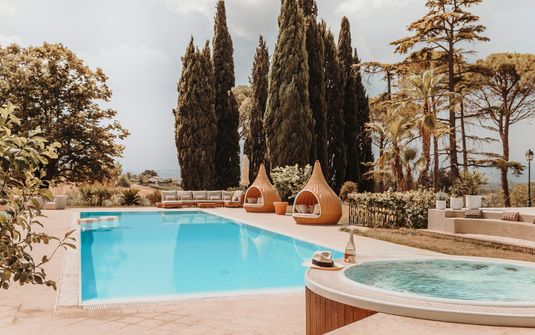
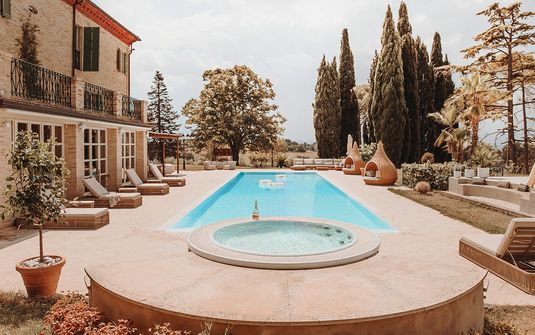
A more formal country villa offers another register through a stronger façade, a more deliberate approach and gardens that give the building room to be read. Mature trees can provide the transition from that architectural order to the less controlled landscape beyond. In either form, the grounds gain depth when they contain different settings: a communal terrace close to the main rooms, a quieter planted edge and a protected area that gives private suites a more intimate outlook.
Materials with a Local Residential Character
Brick, stone, rendered surfaces and tiled roofs appear across the regional building landscape, with individual combinations giving houses their particular identity. Older interiors may retain substantial walls, timber structure and a sequence of rooms that reflects several stages of development. A thoughtful restoration allows those differences to remain visible. Contemporary furniture and discreetly integrated comfort can bring ease without erasing the proportions and material texture that make the residence feel rooted in its setting.
The interior is most welcoming when it offers a range of scales. A larger communal room may occupy a generous original volume, while smaller chambers provide a library-like atmosphere or a quieter place to withdraw. Variation in ceiling height, light and outlook gives these rooms individual roles. The household can then establish several routines within one home, preserving the intimacy of a country residence rather than treating every interior as another version of the same expansive reception space.
An Estate Shared with Independence
The relationship between the main house and any guest accommodation shapes the stay. A separate wing or ancillary building can give couples or different generations greater autonomy, while bedrooms within the principal building create a closer household pattern. The appropriate plan is the one that keeps those arrangements coherent. Private rooms should have comfortable proportions and clear circulation, allowing the group to remain together without requiring every guest to experience the residence in precisely the same way.
Rural privacy is also a matter of orientation. The placement of neighboring houses, access lanes and open ground can affect individual terraces and windows even on a generous plot. Mature planting and established boundaries may provide more meaningful protection than acreage alone. A residence feels genuinely discreet when the rooms and exterior areas used most often by the household are comfortably enclosed, while the wider landscape remains present through selected views rather than continuous exposure.
A Quietly Substantial Italian Address
Marche suits guests who appreciate an architectural landscape with a strong sense of ordinary continuity. Fields, villages and country houses belong to the same visual world, giving a private estate context beyond its boundary. The details of the home can become the defining impressions of the stay: an old doorway, the depth of a window and a familiar view over the hills. These are lasting qualities that do not depend on conspicuous features or a ceremonial atmosphere.
The region’s most compelling private experience is therefore a coherent relationship between house, grounds and surrounding country. A residence with varied interiors, balanced suites and protected exterior spaces can give the household a complete domestic environment, generous enough for shared time and intimate enough for individual retreat. Marche offers that setting with a distinctive central Italian character, shaped by its cultivated hills, material traditions and the gradual meeting of the Apennine landscape with the Adriatic.


