




Burgundy: Private Estates and the Substance of Rural France
Burgundy offers a country-house experience grounded in the texture of the land and the permanence of its buildings. Vineyard slopes, cultivated fields, woodland and stone settlements create a landscape with considerable variation, yet a remarkably settled character. Within France, the region is especially compelling for guests who value an estate with architectural depth and a private setting that feels connected to a working rural environment rather than arranged as a decorative backdrop.
The residential appeal extends beyond the image of a grand château. Former farmhouses, manor houses and substantial country properties can offer different kinds of intimacy, from a sheltered courtyard to gardens opening onto a broader agricultural panorama. What unites them is the possibility of a stay with a strong domestic center. The house, its outbuildings and the surrounding land can form a complete setting in which the household has room to establish its own rhythm.
A Landscape of Cultivation and Enclosure
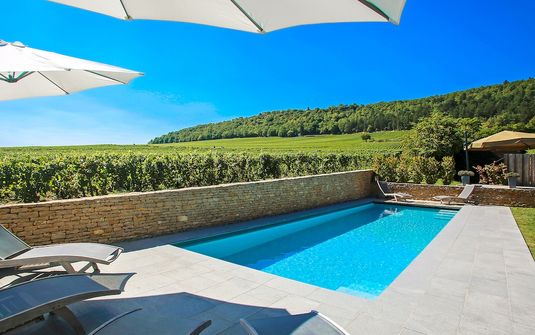
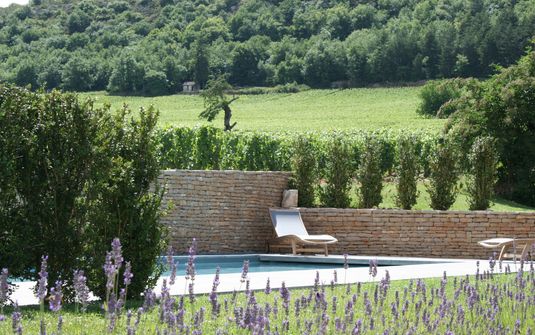
Burgundy’s countryside often gains its character through measured changes rather than abrupt spectacle. A cultivated slope may give way to woodland, while a village gathers around a compact arrangement of stone façades and pitched roofs. These transitions make the foreground of a residence particularly important. An old wall, a line of mature trees or the geometry of neighboring fields can contribute as much to the atmosphere as a distant view across the wider landscape.
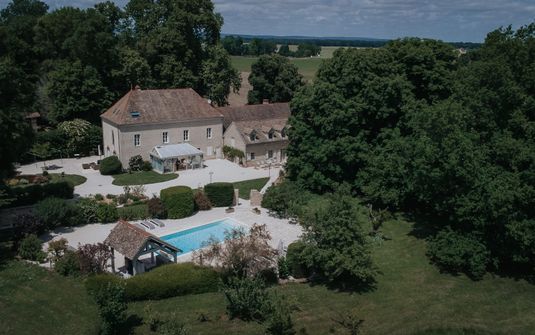
A property within a village belongs to an architectural ensemble, with its privacy frequently concentrated behind walls or within a rear garden. A detached estate can create a more expansive sense of arrival, allowing the principal house to emerge gradually through its grounds. The two settings offer different experiences of rural life. One draws strength from enclosure and continuity with neighboring buildings; the other places greater emphasis on land, distance and the composition of the estate itself.
Courtyards, Walls and Mature Trees
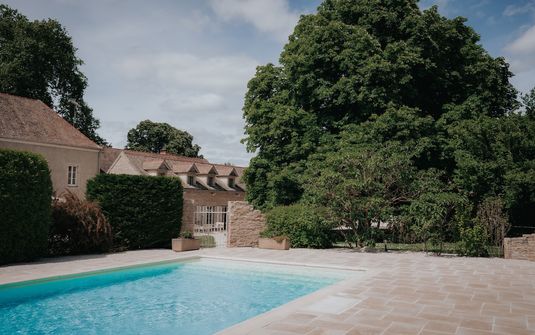
The courtyard is an especially expressive element of a traditional country property. It can bring the main house and ancillary buildings into a coherent arrangement while creating an exterior space with a scale distinct from the open countryside. Stone surfaces, substantial doorways and the shade of an established tree give such a setting depth without requiring elaborate ornament. When the principal rooms open towards it, the courtyard becomes part of the residence’s daily architecture rather than simply an entrance feature.
Beyond that enclosed core, gardens and parkland introduce a different pace. A formal approach may give way to more relaxed lawns, orchard planting or a wooded boundary. The quality of these spaces lies in their relationship to the house: whether they offer a natural extension of a room, protect the household from neighboring sightlines or create a quieter outlook for a private suite. Mature grounds can give a stay a sense of continuity that newly composed landscapes rarely reproduce.
Buildings with a Legible History
Burgundian residences may retain deep masonry walls, timber roof structures, stone staircases and substantial fireplaces. These features make the building’s history tangible, but their appeal depends on careful integration with present-day comfort. An old house should not require the household to negotiate an inconvenient plan simply to experience its character. Thoughtful restoration allows original proportions and materials to remain visible while making the rooms feel welcoming, coherent and suitable for a sustained private stay.
Interiors can range from quietly traditional to markedly contemporary. In a historic shell, restrained furnishings and well-placed artwork may reveal the architecture more clearly than a heavily themed decorative scheme. A large former agricultural volume can support a generous communal room, while smaller original chambers retain an intimate scale. This contrast between spaces gives a country residence variety and allows different parts of the household to occupy it without every room feeling like a variation on one formal reception area.
The Estate as a Shared Private World
For a larger group, the relationship between the main house and any separate guest accommodation deserves particular attention. An independent wing or outbuilding can offer useful separation, but it also changes how closely the household remains connected. Within the principal house, several reception rooms can support parallel routines without dispersing the group across the estate. The strongest arrangement makes independence available while preserving a natural center around which the stay can take shape.
Discretion in a rural property is often created by a sequence of boundaries. The edge of the estate, the orientation of the house and the placement of gardens each contribute to the experience. A residence can feel secluded without being isolated, especially when its most-used rooms face inward towards protected grounds. This layered privacy is more meaningful than acreage alone, because it determines how comfortably the household can inhabit the property rather than simply how much land surrounds it.
A Stay Defined by Permanence
Burgundy’s luxury is often quiet and substantial. It is present in the depth of an old wall, the scale of a mature garden and the relationship between a house and the cultivated land beyond it. These are not interchangeable features; they give a private residence its particular identity. The region suits guests who appreciate buildings that have retained a sense of purpose and surroundings that feel established rather than staged for a brief impression.
An extended stay allows those qualities to become part of the household’s experience. Rooms acquire familiar roles, the grounds reveal their different scales and the residence begins to feel like a complete private setting. Burgundy offers that possibility with unusual architectural richness. A well-considered estate can provide generous comfort and independence while remaining closely connected to the region’s stone buildings, agricultural patterns and enduring sense of rural continuity.


