


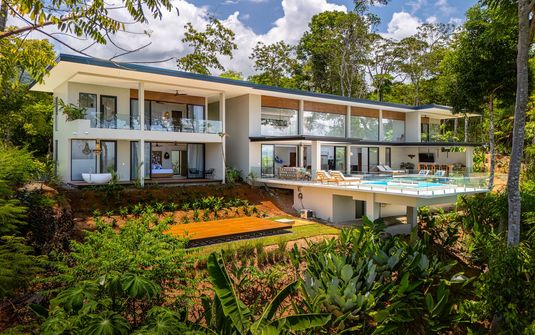
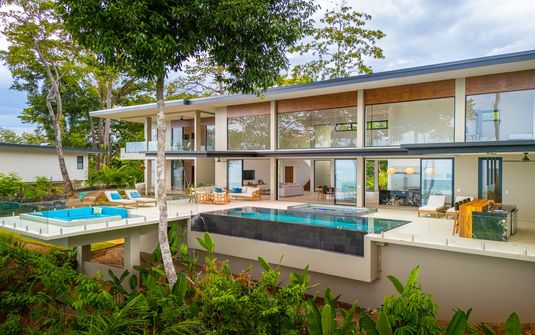


Costa Ballena has an unusually immediate relationship between mountain and ocean. Along this southern Pacific stretch of Costa Rica, wooded slopes rise behind a coastal ribbon of broad beaches, river mouths and rocky points. From a carefully positioned villa, the forest can feel close enough to enclose the rooms while the sea opens far beyond it. This combination gives the destination its distinctive residential character. The setting is lush and expansive, yet a house can remain deeply private, with its architecture placed within the folds of the land rather than standing apart on a cleared and exposed platform.
The name embraces the coastal landscape around Dominical, Uvita and Ojochal, each contributing to a region whose identity is larger than any single settlement. The precise experience depends on the parcel. A residence above a river valley may look across several layers of green, while another faces a long sweep of shoreline from a steeper ridge. Lower properties can feel more closely connected to gardens and the coastal plain. These are meaningful distinctions for a household choosing a private home. Costa Ballena rewards attention to its varied topography, because elevation, orientation and vegetation can change the atmosphere considerably within a relatively small area.
A coast shaped by forested mountains
The hills give the landscape a powerful vertical dimension. Rather than receding gradually inland, the terrain often gathers quickly into wooded ridges, placing high viewpoints above the ocean. A villa on one of these shoulders can command a long prospect without feeling detached from the forest. The canopy becomes the foreground, the coastal plain the middle distance and the Pacific the final horizon. That layered composition is one of Costa Ballena's greatest assets. It gives the view depth and movement, allowing a room to feel intimate at its edges even when its main opening addresses a vast expanse of water.
The shoreline introduces softer geometries below the ridges. Broad arcs of sand, dark rock and the changing outlines around river mouths create a coast that resists a single postcard composition. Near Uvita, the distinctive form of the coastal sandbar gives the landscape a recognizable identity, though its visibility from a residence depends on the exact position of the property. Such features are best understood as part of the region's character rather than a promised view from every terrace. A well-sited house frames what belongs to its own outlook, allowing the broader coastline to retain its scale and complexity beyond the estate.
Vegetation provides both richness and enclosure. Large leaves, tall trunks and dense lower growth can create several layers between the house and its boundaries. Preserving that structure gives a villa a sense of belonging within the landscape, particularly on a steep site where extensive clearing would make every platform visible. The garden need not be highly formal. Carefully edited planting around terraces and paths can establish order while retaining the impression of a larger forest beyond. This is a subtle form of luxury: the property feels composed and comfortable, but the setting continues to have a life and presence of its own.
Contemporary villas within the canopy
The most convincing architecture here takes its cues from the slope. Separate pavilions can occupy different levels, connected by sheltered passages or short garden transitions. A long main volume can follow a contour, opening toward the sea while keeping support spaces against the uphill side. These arrangements reduce the need for an oversized platform and allow the residence to retain contact with the trees. The result can be architecturally ambitious without overwhelming the site. Large roof planes and clear structural lines provide order, while the spaces between buildings admit planting, light and glimpses of the terrain that would disappear within a single massive block.
A restrained material palette is particularly effective against such dense vegetation. Timber brings warmth to ceilings and shutters, pale plaster gives interiors clarity, and stone anchors retaining walls and garden edges. Concrete can provide a quiet structural presence when its proportions and finish are carefully considered. The strongest details are often the least conspicuous: a recessed threshold, a clean junction between roof and column, or a sliding screen that disappears neatly when open. These elements allow the architecture to work with precision while the forest supplies texture. Decorative abundance is rarely necessary in a setting that already offers so much visual depth.
The approach to a hillside villa can establish a gradual sense of withdrawal. The house may first appear as a roof among trees, then as a shaded entry court, with the ocean withheld until the principal pavilion is reached. This progression makes the view feel earned without turning arrival into a performance. It also creates a useful privacy sequence, separating the surrounding landscape from the interior of the residence. Practical access should be handled with equal care. A clear guest entrance and discreet support areas let the property retain its calm, even when a full household occupies several pavilions across the slope.
Rooms with a forest edge
Living spaces in Costa Ballena are most rewarding when they acknowledge the close landscape as well as the distant sea. A great room may open broadly toward the horizon, while a side window frames a mature tree or a planted court. This second perspective keeps the house from becoming a single repeated view. Deep openings create shade and visual weight, making even large areas of glass feel settled within the structure. Inside, several seating groups can accommodate conversation without obstructing the outlook. The room should remain comfortable as a place to inhabit, with the landscape enriching its atmosphere rather than dictating every piece of furniture.
Bedroom planning can use the natural folds of the site to establish independence. A principal suite may sit beyond the central terrace, while guest pavilions occupy quieter levels with their own garden edges. Comparable room quality matters more than identical views. One suite may look toward the ocean, another into the canopy, each offering a distinct and appealing relationship to the setting. The connections between them deserve attention, especially for a multigenerational household. A beautiful dispersed plan works best when its stairs, passages and changes in level fit the guests' preferences, allowing privacy to feel effortless rather than physically demanding.
Bathrooms can extend the sense of contact with the landscape through carefully controlled views. A planted wall, a private court or a high opening toward the trees can give the room depth without compromising discretion. Natural stone and timber details help these spaces feel part of the same architectural language as the principal rooms. Generous storage and thoughtful lighting contribute to comfort over a longer stay, while clear separation between wet and dressing areas keeps the suite practical. The most accomplished private quarters feel calm and complete, offering a place of retreat within a property whose shared areas may be deliberately open and expansive.
Outdoor space with several degrees of enclosure
An ocean-facing pool can be the visual center of a Costa Ballena villa, but its surroundings determine how the exterior is actually experienced. A broad open edge may be balanced by a deeply shaded lounge, a smaller garden court or a terrace partly enclosed by the house. These spaces give guests choices without requiring them to leave the property's central sequence. The pool itself should sit comfortably within the terrain, with its structure absorbed into stonework and planting where possible. When the details are resolved, the water becomes one element in a larger composition of roof, forest and horizon rather than an isolated architectural gesture.
Privacy is strongest when the plan understands the hillside from every direction. Dense planting can screen lateral views, but neighboring sites above or below may still influence the experience of a terrace. Roof orientation, retaining walls and the positioning of suites can resolve those relationships more reliably than vegetation alone. A sheltered court on the uphill side may offer a different kind of quiet from the main seaward platform. The property gains depth when both are treated as valuable spaces. This allows the household to move between panoramic openness and close enclosure, a contrast that feels particularly natural in Costa Ballena's folded landscape.
Shared life within the villa benefits from a clear central pavilion and smaller places of withdrawal. A family can gather in a generous living room, while a separate salon or shaded passage accommodates a quieter conversation. Several couples may appreciate bedrooms distributed across the property, provided each has a comfortable route to the shared rooms. The architecture should make these relationships intuitive. A residence with many terraces is not automatically flexible if all of them lie along the same exposed frontage. The most successful plan offers distinct settings with different scales, orientations and levels of privacy, allowing the house to remain comfortable at full occupancy.
The importance of a well-resolved hillside plan
Service and support spaces require particular intelligence on a steep site. The uphill edge can accommodate storage, laundry and staff work areas, preserving the principal frontage for guests. Separate circulation can keep routine movements from crossing the main terrace, while thoughtful distribution reduces unnecessary travel between pavilions. Mechanical equipment should be concealed without compromising the clarity of the plan. These decisions are part of the quality of the residence, even when they remain invisible. A villa that operates smoothly lets its architecture feel relaxed, with the household experiencing the calm result of practical planning rather than the effort required to sustain it.
When comparing properties, the exact view corridor is more useful than a broad description of elevation. A high house may have a narrower seaward opening than a lower one, depending on the surrounding ridges and tree cover. The amount of level terrace, the parity of guest suites and the protection of outdoor rooms should be considered alongside the panorama. Architectural photographs can emphasize the most dramatic axis while leaving the rest of the plan less clear. A careful reading of the property reveals whether its strongest qualities extend throughout the residence, creating a home that remains satisfying beyond the first impression.
A southern Pacific perspective
Costa Ballena occupies a distinctive place within Central America: a coastal landscape where substantial mountain relief and close forest remain central to the residential experience. Its villas are most persuasive when they preserve that relationship, allowing the natural setting to retain authority around even a highly refined estate. The atmosphere can be sophisticated without becoming formal, and secluded without feeling empty. Carefully placed architecture gives the household a comfortable position within a landscape that continues far beyond the property. That sense of belonging is more enduring than a collection of features, because it arises from the site's own character and cannot be reproduced elsewhere.
Private living between canopy and horizon
A memorable Costa Ballena stay brings the near and distant landscape into balance. The forest provides enclosure, the mountains give the site structure and the Pacific opens the view outward. A well-chosen residence interprets all three through generous rooms, discreet boundaries and exterior spaces that offer more than one way to inhabit the setting. LaCure considers those relationships alongside the needs of the household, seeking a property whose architecture feels coherent at every scale. The result is a private home with depth: expansive where the view calls for it, intimate where guests need retreat, and unmistakably connected to this stretch of Costa Rican coast.


