




Paradise Island: Private Residential Worlds between Harbour and Ocean
Paradise Island occupies a distinctive position across the harbour from Nassau in the Bahamas, with a more developed island setting and several different coastal perspectives. Its northern shore and harbour-facing ground create contrasting relationships to the water, giving private residences a clear sense of context. Within the wider Caribbean world, the appeal is not a uniform promise of remoteness. A house establishes its own domestic atmosphere through its grounds, orientation and private rooms, allowing the household to enjoy a recognisable island address while retaining a personal setting within it.
The compact geography makes the actual position of the residence particularly important. A broad ocean prospect offers another atmosphere from a view across the harbour, and an enclosed garden creates a different private foreground again. These conditions shape the architecture as much as the outlook. The most rewarding home has several degrees of openness, with principal rooms that acknowledge the wider setting and quieter accommodation that feels complete from within. Luxury becomes personal through the balance of those spaces, rather than through the assumption that every property experiences the island in the same way.
Two Different Coastal Relationships
The ocean-facing side of Paradise Island gives the landscape a broad sandy edge and a more open horizon. A residence associated with this setting can make the coast a strong visual reference, but the transition from interior to exterior still requires a domestic scale. A covered terrace, planted boundary or smaller private court can introduce enclosure close to the house. These spaces allow the household to occupy the landscape comfortably, providing alternatives to a single expansive deck and giving more intimate rooms their own attractive relationship to the immediate grounds.
The harbour side introduces another composition, with water set against the inhabited landscape of Nassau beyond. This gives a residence a more layered and recognisably local outlook than an uninterrupted sea horizon. A principal room can frame the broader scene, while a quieter suite turns toward planting or a more protected terrace. The house retains a sense of connection to the surrounding island world without making every space equally exposed. Its character comes from how clearly the private domestic setting is resolved within that wider coastal and residential context.
Villa Sul Mare: A House with Several Related Roof Forms
A Distinctive Waterfront Domestic Plan
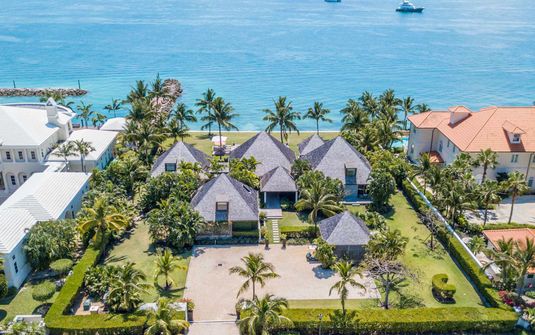
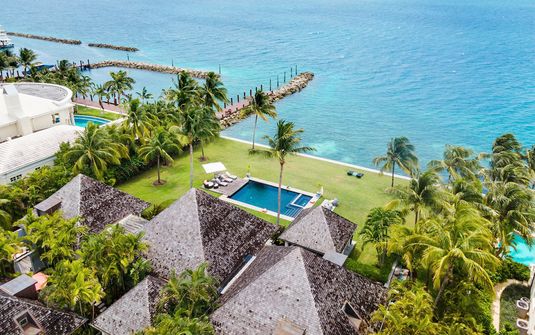
Villa Sul Mare offers an individual architectural expression within Ocean Club Estates on Paradise Island. Its accommodation is arranged beneath several separate roof forms, giving the house a more articulated composition than a single continuous volume. The principal interior connects to a harbour-facing terrace, while landscaped grounds and palms introduce a private foreground around the building. This arrangement gives the residence a recognisable identity beyond its view, with different parts of the house able to retain distinct atmospheres while remaining connected as one private home.
The terrace extends the shared interior into a substantial exterior setting, while the principal suite has its own separate relationship to the outdoors. Such distinctions make a larger residence more rewarding for a household, allowing guests to occupy different spaces without losing the ease of gathering in the main room. The value lies in the coherence of the plan: shared settings remain clearly connected, private accommodation has a meaningful degree of retreat and the grounds bring the architectural elements together. The house feels generous through its variety rather than through one oversized central space alone.
Gardens and a More Composed Island Landscape
Paradise Island has a notable tradition of designed landscape, expressed in the formal terraces and planting of the Versailles Gardens. Their harbour-facing composition gives the island another architectural reference alongside its coastline. A private residence need not reproduce that formality to benefit from the broader idea of an outdoor sequence. A planted court, a framed entrance garden or a more intimate terrace can give the grounds clear structure, allowing the house to reveal its setting gradually and creating spaces whose atmosphere is defined by enclosure as well as outlook.
The close landscape becomes especially important in ordinary use of the home. A garden wall viewed from a bedroom, planting beside an interior passage or a sheltered exterior corner can offer a quiet counterpart to the principal coastal view. These elements give secondary rooms a purpose and visual interest of their own. The residence feels complete because its private world is rewarding from several positions, not only from the main terrace. Gardens become part of the domestic composition, connecting rooms and giving the household several attractive settings within the property’s boundary.
Architecture with Personal Interior Depth
Contemporary coastal forms can bring clarity to a Paradise Island residence through simple volumes, broad openings and a measured relationship between interior and terrace. More articulated rooflines and separate wings offer another domestic rhythm. The quality of either approach depends on the proportions of the actual rooms and the privacy of their arrangement. A bedroom should feel distinct from the principal gathering space, while shared interiors remain comfortable when occupied by only a few guests. The architecture becomes convincing through everyday usefulness as much as through the impression made by its exterior.
Material detail gives that usefulness warmth and individuality. Timber joinery, textured surfaces and comfortable furnishings can make quieter rooms appealing independently of their outlook. A more enclosed bedroom, a garden-facing sitting area or an interior corner suited to reading gives the house several moods without fragmenting its identity. Recurring finishes can hold those differences together, allowing each room to retain a particular purpose. Over a longer stay, these smaller qualities become increasingly important, with the household settling into spaces that feel comfortable and personal rather than merely impressive at first glance.
Discretion within an Established Island Address
Privacy on Paradise Island remains specific to the chosen property. The position of neighbouring buildings, the direction of windows and the enclosure of exterior rooms influence how secluded a space feels. Within the residence, separate suites and quieter circulation allow guests to follow different daily rhythms without losing the ease of shared life. These resolved relationships give discretion a practical form, balancing a recognisable destination with a private household atmosphere. A thoughtful home supports time together while preserving spaces that feel distinctly personal, allowing its rooms and grounds to remain useful throughout an extended stay.
Paradise Island offers a varied residential setting between ocean and harbour, with private houses that can interpret those conditions in different ways. The individuality of a home such as Villa Sul Mare, the island’s designed landscape and the contrast between coastal outlooks give the destination depth beyond a single image of waterfront luxury. A coherent residence brings those elements into focus through its rooms, grounds and actual position. The result is a private Bahamian stay grounded in place, with enough comfort, architectural character and spatial variety to feel settled and personal over time.


