




Grand Bahama Island: Private Homes within a Broad Coastal and Woodland Landscape
Grand Bahama Island offers a substantial island setting within the Bahamas, with established residential areas, long stretches of coast and an interior landscape that includes pine woodland. Its identity is broader than one beach or one private enclave. Within the wider Caribbean world, a stay here can feel grounded in a recognisable island community while retaining the privacy of an individual home. The actual address determines the balance: a coast-facing estate, a house within planted grounds or a more contained residence creates a different atmosphere for the household within it.
The low coastal ground gives architecture and landscape design an important role in establishing intimacy. A house may open broadly toward the sea, but its garden edges, private courts and quieter interiors provide a more domestic scale close to the building. The residence becomes rewarding when those settings have distinct purposes rather than repeating one panoramic arrangement throughout. Grand Bahama’s appeal lies partly in this range of possibilities, allowing guests to choose a home whose proportions and relationship to the surroundings feel appropriate to the way they wish to spend time together.
A Landscape beyond the Shoreline
Pine forest, coppice woodland, mangroves and sandy coast form part of Grand Bahama’s wider natural character. Their presence gives the island a visual identity that extends beyond the familiar image of pale sand and blue water. A private residence need not contain all of those landscapes to belong to the island, but the contrast helps explain its breadth. A garden-centred home can feel as grounded in place as an immediately coastal property, with planting and enclosed exterior rooms providing an intimate foreground within a larger island setting.
Residential context adds another layer to that experience. Established communities and individual coastal addresses create different relationships between private house and surrounding ground, making the immediate position of the property important. A broad outlook does not by itself make a home secluded, and a more enclosed parcel can feel generous through the quality of its rooms and garden. The most comfortable stay comes from a residence whose boundaries, orientation and exterior spaces are resolved as part of one composition, giving the household a clear private setting within the actual neighbourhood.
Nandana: A Pavilion Estate at West End
Natural Materials and Separate Residential Volumes
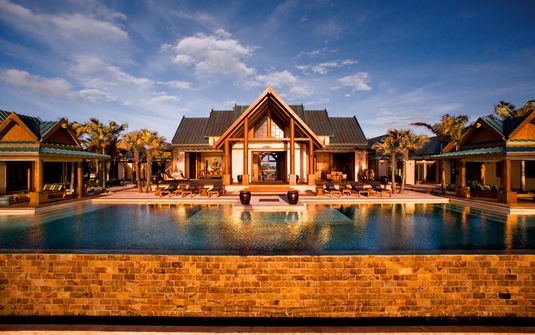
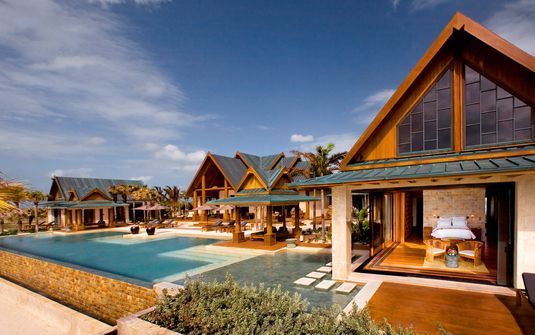
Nandana provides a distinctive example of the larger private residential scale represented on Grand Bahama. Set at the island’s western end, the estate uses an Asian-influenced beach-house language and several separate buildings to create a varied domestic composition. Teak and natural stone give the interiors a strong tactile identity, introducing warmth and texture alongside the coastal outlook. The architecture is recognisable from within as well as from its exterior, with materials and room proportions carrying much of the experience rather than leaving the surrounding sea to supply the residence’s entire character.
The separation of the principal building and private pavilion accommodation creates several degrees of retreat within one estate. Sea-facing pavilions have their own exterior relationship to the setting, while the main rooms provide a shared domestic centre. This arrangement can make a substantial property feel more intimate in use, with individual buildings giving accommodation a distinct identity. The grounds and connecting spaces become important parts of the architecture, holding the estate together as a coherent home rather than simply distributing rooms across a larger parcel of land.
Private Living at a More Contained Scale
Grand Bahama’s residential range also includes individual homes such as Jasmine on the Isle, offering another scale alongside the more extensive pavilion-estate format. A smaller domestic footprint places particular emphasis on the principal room and its connection to the exterior. A well-proportioned veranda, an attractive garden aspect or a quieter secondary sitting area can give the home variety without requiring several separate buildings. The appeal is personal, with rooms that remain comfortable for only a few guests and enough clear separation to support a shared household over an extended stay.
The choice between these formats is architectural as well as spatial. An estate of separate buildings allows a greater degree of independence, while a contained house can make shared life feel immediate and familiar. Neither depends solely on the number of bedrooms. The quality lies in how the main rooms, private accommodation and grounds relate to one another. A coherent residence gives guests choices within the property, allowing them to gather naturally and withdraw comfortably while continuing to inhabit one recognisable home with a clear domestic centre.
The Private Foreground to a Coastal Outlook
Where a house faces the sea, the space between interior and shore deserves particular attention. A covered exterior room can create a sheltered threshold, while a garden or pool terrace introduces another scale before the wider water. These settings should feel useful in their own right rather than functioning only as viewing platforms. Their proportions, furniture and boundaries determine how naturally they become part of household life. A larger terrace can accommodate everyone, while a smaller protected corner offers a quieter relationship to the same coastal setting.
Private suites benefit from a different degree of enclosure. A planted court or garden-facing window can give a bedroom an attractive outlook without making it part of the principal shared terrace. Within the house, quieter circulation and secondary rooms allow different daily rhythms to coexist. These choices give privacy a practical form, both at the boundary of the property and within the household itself. The residence feels generous because guests can spend time together without every private space remaining visually or acoustically connected to the main gathering area.
Interior Character for a Longer Island Stay
Grand Bahama’s private homes are most rewarding when their interiors have enough substance to remain appealing independently of the view. Comfortable furnishings, thoughtful lighting and a material palette with texture give rooms a domestic warmth that becomes increasingly valuable over time. A bedroom can feel more enclosed than the principal lounge, while a quieter room provides space for reading or focused work. These variations allow the residence to acquire a familiar rhythm, with guests returning to particular settings because they are comfortable to inhabit rather than simply impressive at first glance.
Grand Bahama Island combines a broad natural landscape with several distinct forms of private residential life. A pavilion estate such as Nandana and more contained individual homes offer different ways to establish a personal setting within the island. The most persuasive luxury comes from the coherence of the chosen residence: grounds that create a clear private foreground, rooms with distinct purposes and a considered relationship to the actual site. The result is a home whose comfort, architectural character and spatial variety can sustain a longer Bahamian stay beyond its principal coastal outlook.


