
Why Travelers Keep Returning to Spain
Spain draws people back because it never runs out of new places to discover. One country holds green Atlantic valleys, Mediterranean coves, island fincas, Moorish palaces and Gothic cathedrals, all tied together by a way of life built around the table. A luxury villa holiday in Spain can feel different every time, depending on the region you choose.
That range is the heart of it. Our Spain destination page brings together homes from the Balearic Islands to the north coast, and this guide looks at the lasting qualities that make the country worth knowing more deeply, along with ideas for a return trip that goes somewhere new.
Many Countries in One: Spain's Lasting Range
Spain's appeal endures because its regions are genuinely different from one another, in landscape, language, food and architecture. Covering most of the Iberian Peninsula, it borders France and Andorra in the north and Portugal in the west, with the Atlantic and the Bay of Biscay on one side and the Mediterranean on the other.
These are the broad worlds within it:
The green north. Galicia, Asturias, Cantabria and the Basque Country face the Atlantic and the Bay of Biscay. Rain keeps the hills green, and fishing ports and stone villages line the coast.
The Mediterranean coast. From Catalonia's Costa Brava south through Valencia to Andalusia's Costa del Sol, the east and south coasts bring warm summers, coves and long beaches.
The Balearic Islands. Mallorca, Menorca, Ibiza and Formentera each have their own character, from mountain villages to pine-fringed coves.
The interior. The high central plateau, the Meseta, holds Madrid, Toledo, Salamanca and the open plains of Castile, with hot summers and cold winters.
The mountains. The Pyrenees run along the French border, and the Sierra Nevada rises above Granada in the south.
The Canary Islands. Volcanic islands off the coast of northwest Africa, with a mild climate through the year.
This variety means a second or third visit can feel like a first. A trip to the Basque coast shares little with a week in Mallorca, and neither resembles a stay among the white villages of Andalusia.
Heritage That Rewards Every Return
Spain's history is layered, and each region shows a different chapter. That depth is one of the strongest reasons the country stays interesting over many visits.
Rome left its mark across the peninsula. The aqueduct of Segovia still strides across the old town, and Mérida in Extremadura holds a Roman theater and bridge. Tarragona, on the Catalan coast, was the Roman city of Tarraco, and its amphitheater still stands above the sea.
From the eighth century, much of the peninsula became al-Andalus, under Muslim rule. Its legacy is most visible in the south: the Alhambra in Granada, the Great Mosque of Córdoba and the Alcázar of Seville. The Christian kingdoms of the north, meanwhile, built the Romanesque churches of Castile and Aragon and the Gothic cathedrals of Burgos, León and Toledo.
Later centuries brought the Golden Age of Spanish art and literature, the painters Velázquez and Goya, and in the twentieth century Picasso, Miró and Dalí. In Barcelona, Antoni Gaudí's buildings, including the Sagrada Família, gave the city its unmistakable modernist skyline. Our Barcelona page is a good starting point for a city stay.
Pilgrimage adds another thread. The Camino de Santiago, a network of medieval routes leading to the cathedral of Santiago de Compostela in Galicia, has been walked by pilgrims since the Middle Ages.
Wild Landscapes Beyond the Coast
Spain's natural landscapes are as varied as its cities, and they are a lasting reason to come back. Much of the country is mountainous, and its national parks protect a remarkable range of scenery.
In the north, the Picos de Europa rise steeply behind the Cantabrian coast, with limestone peaks, deep gorges and high pastures. The Picos became Spain's first national park in 1918. Further east, the Ordesa valley in the Aragonese Pyrenees is carved into towering canyon walls and waterfalls.
In the south, Doñana National Park protects marshes, dunes and pine woods where the Guadalquivir meets the Atlantic, an important stop for migrating birds. On Tenerife in the Canary Islands, Teide National Park surrounds a vast volcanic crater and the peak of Mount Teide.
Closer to many villa regions, the hills are part of everyday life. In Mallorca, the Serra de Tramuntana runs along the island's northwest coast, terraced with olive groves and stone walls, and is recognized by UNESCO as a cultural landscape. In Ibiza, pine woods and farmland cover the interior. Walking, cycling and simply driving these back roads show a side of Spain that a beach holiday alone can't.
The Daily Rhythm of a Luxury Villa Holiday in Spain
Spain's daily rhythm is one of its most lasting pleasures, and a private villa suits it well. Days unfold later and more slowly than in much of northern Europe, and meals sit at the center of them.
Lunch is the main meal in much of Spain, served from early afternoon, and dinner often begins late in the evening. Between them comes the tradition of sobremesa, the time spent lingering at the table after a meal, talking long after the plates are cleared. In the early evening, the paseo, a gentle stroll through town, brings streets and squares to life.
Food changes from region to region:
The north. The Basque Country has its pintxos, small bites served on bread, and Galicia its seafood.
Valencia. Paella began in the rice-growing lands around the city.
Andalusia. Gazpacho, salmorejo and fried fish suit the southern heat, and sherry comes from the area around Jerez.
The interior. Roast meats, Manchego cheese from La Mancha and cured ibérico ham are staples.
The islands. Mallorca has its ensaïmada pastry and sobrassada sausage.
With a home of your own, you can follow that rhythm at your own pace: a late breakfast on the terrace, a long lunch under a pergola, a swim before an evening walk into the village. A luxury Spanish villa makes the table the center of the day, just as it is across the country.
Seasonal Rituals Worth Planning Around
Spain marks the year with festivals and traditions, and building a trip around one gives a return visit a new focus. These are some of the most established:
Semana Santa. Holy Week, the week before Easter, brings processions to cities and towns across the country.
Las Fallas. In March, Valencia fills with enormous satirical sculptures, which are burned at the end of the festival.
San Fermín. Pamplona's July festival includes the running of the bulls.
The autumn harvest. Wine regions across the country celebrate the grape harvest each autumn.
Towns and villages also hold their own local fiestas and fairs, often in summer. Our team can help you plan around a local celebration once you've chosen your region.
How a Return Trip Can Differ From a First
A return to Spain is a chance to see a side of the country that feels entirely new. If your earlier trips centered on Barcelona, Madrid or the Costa del Sol, there's a great deal more to explore.
Consider a few different directions:
Go north. The coast of Asturias offers green hills, estuaries and the Picos de Europa mountains.
Try the islands in a different season. Mallorca in spring or autumn suits walking in the Serra de Tramuntana and exploring its stone villages.
Go inland. The cities of Castile, from Toledo to Salamanca, reveal Spain's medieval and Renaissance heart.
Slow down in the south. Andalusia's white villages and country houses reward a longer, unhurried stay away from the coast.
See a different island. Ibiza has a rural interior of farmhouses, terraced fields and pine woods alongside its coast.
When to Visit Spain
Spain's climate varies by region, so the right season depends on where you go. The Mediterranean coast and the Balearic Islands have hot, dry summers and mild winters. The Atlantic north is milder in summer and wetter year-round, which keeps it green. The interior has hot summers and cold winters, and the Canary Islands stay mild through the year.
Summer is the high season on the coasts and islands, as are the Christmas and Easter holidays. Spring and autumn suit city visits, walking and touring, with warm days and comfortable evenings in most regions.
Getting Around Spain
Spain is straightforward to travel once you know its shape. Major airports include Madrid-Barajas, Barcelona-El Prat, Málaga-Costa del Sol, Palma de Mallorca and Ibiza.
A high-speed rail network links Madrid with many of the country's major cities, which makes combining regions easy. For countryside villas, a car or arranged transfers make daily life far simpler, and our team can arrange transfers to your home.
Spain uses the euro. The mainland and the Balearic Islands run on Central European Time, while the Canary Islands are an hour behind. Spanish is the national language, and Catalan, Basque and Galician are also official languages in their regions.
Our Homes for a Return to Spain
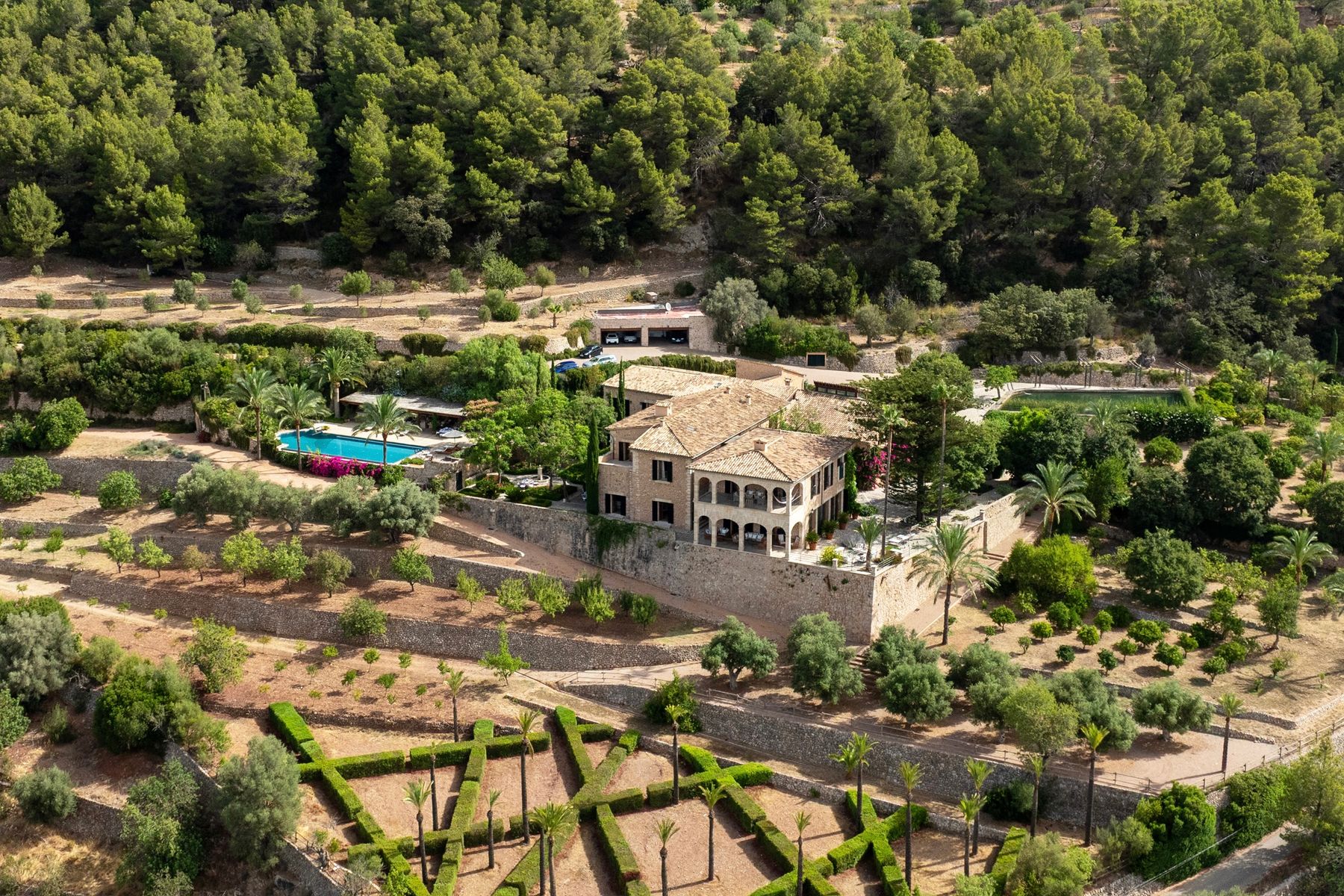
Our luxury villas in Spain range across islands, coasts and countryside. The homes below each open a different side of the country, from a mountain estate to a north-coast palace and an island villa.
In Mallorca, our listing places Son Simonet above the village of Esporles, on a 30-acre estate in the foothills of the Serra de Tramuntana, a UNESCO World Heritage landscape. The estate was originally built more than 500 years ago as an olive farm and has been restored, keeping its original architecture alongside contemporary interiors. Olive and citrus trees surround a pool with an outdoor bar and shaded pergola, and three separate outdoor dining areas are set across the grounds. The listing also features a lounge with a bar and wine cave, fitness equipment and staff quarters, with concierge service, daily housekeeping and live-in staff among the listed services. According to our listing, Valldemossa is 9.4 kilometers away, Palma 19.6 kilometers and Palma de Mallorca Airport 23.5 kilometers.
On Spain's north coast, our listing describes Palacio de Figueras as a 16th-century palace overlooking the port on the Eo estuary, in a waterfront setting with landscaped grounds that descend toward the water. Terraced gardens hold a heated pool and several spaces for outdoor dining, and inside, original character sits alongside an elevator, a library and a children's activity area. Daily housekeeping and a host are listed, and daily breakfast can be arranged. According to our listing, the Port of Ribadeo is 5 kilometers away, Playa de las Catedrales 14.9 kilometers and Asturias Airport 91.3 kilometers. As a family-friendly villa with games, cots and high chairs listed, it suits several generations.
On Ibiza's southwest coast, Villa Bora looks out over the sea toward Porroig, Formentera and Salinas, according to our listing. A saltwater pool with a pool bar, a hot tub, indoor and outdoor fireplaces and an outdoor dining area make the most of its views. According to our listing, Jondal Beach is 9.5 kilometers away, Ibiza Town 16.5 kilometers and Ibiza Airport 13.6 kilometers.
How We Plan a Return to Spain
The right home depends on the Spain you want to see next. We'd suggest Son Simonet for a return built around Mallorca's mountains and villages, Palacio de Figueras for the green north, and Villa Bora for the sea and the island light.
For villas for groups, we look at how the house lives as much as its size: shared dining spaces, outdoor areas and how the setting fits the days you have in mind. Our team can arrange transfers, provisioning before you arrive and help with excursions. Every home in our collection is personally inspected before it joins, and every stay has a pre-arrival check.
Coming Back to Spain
Why travelers keep returning to Spain is no mystery once you see its range: many regions, many histories and a rhythm of life that invites you to slow down. A luxury villa holiday in Spain can take you somewhere new every time, from the Tramuntana foothills to the Eo estuary and the Ibiza coast.
Explore our homes across Spain and the wider Europe collection, and when you're ready to plan your next stay, we're here.

Our Destinations


