
What Most Travelers Don't Know About Menorca
Menorca is a protected island with a prehistoric past, not simply a smaller version of its Balearic neighbors. The whole island has been a UNESCO Biosphere Reserve since 1993, its prehistoric Talaiotic sites joined the World Heritage List in 2023, and its two coasts look and feel like different places. Those are the first things to know about Menorca.
Much of what gives Menorca its character sits away from the shoreline: farmland divided by dry-stone walls, prehistoric stone towers, and two historic towns that face each other across the length of the island. Here is what's worth understanding before you plan a stay.
Things to Know About Menorca Before You Go
Menorca is the second-largest of Spain's Balearic Islands, lying to the east of Mallorca in the western Mediterranean. It's a rural, low-rise island where agriculture still shapes the landscape, and a few facts change how you see it:
The whole island is a biosphere reserve. The designation covers all of Menorca, with the wetlands and dunes of S'Albufera des Grau Natural Park in the northeast at its core.
Its prehistoric sites are internationally recognized. Talaiotic Menorca was inscribed as a UNESCO World Heritage Site in 2023.
It has two capitals in its story. Mahón is the capital today, while Ciutadella held that role for centuries before it.
Britain ruled it for much of the 18th century. That era left its mark on Mahón's architecture and on a local gin-making tradition.
Two languages are spoken. Catalan, in its Menorcan form, sits alongside Spanish on signs, menus and in daily life.
A Prehistoric Landscape Hiding in Plain Sight
Menorca's most remarkable feature isn't a beach. It's the hundreds of stone structures left by the Talaiotic culture, which flourished on the island from the Bronze Age into the Iron Age. They appear in fields, beside farm tracks and on low hilltops, often with sheep grazing around them.
Three types are worth recognizing:
Talaiots are the stone towers that give the culture its name, likely used as lookouts or community structures.
Taulas are tall T-shaped monuments made from two great slabs of stone, and their purpose is still debated by archaeologists.
Navetas are communal tombs shaped like an upturned boat. The Naveta des Tudons, near Ciutadella, is a well-preserved example.
What makes these sites special is how ordinary their setting feels. There are no grand approaches, just stone walls, wild olive trees and open sky, which lets the age of the place speak for itself.
Two Coasts, Two Different Islands
The north and south of Menorca feel like separate destinations. The north coast is rugged and indented, with darker rock, headlands and a landscape exposed to the tramuntana, the strong northerly wind that shapes the island's trees and fields, especially in winter. The Favàritx lighthouse stands on this side, in a stark, almost lunar setting of dark slate.
The south is gentler. Limestone cliffs are cut by deep ravines, called barrancs locally, that run down to small coves framed by pine woods. Between the two coasts, farmland rolls across the interior toward Monte Toro, the island's highest point, which has a hilltop sanctuary and views over much of Menorca.
Linking it all is the Camí de Cavalls, a historic bridleway that once let mounted guards patrol the coastline. Today it's a waymarked path circling the island, and walking even a short stretch shows how varied the shore really is.
Mahón and Ciutadella: A Tale of Two Towns
Menorca's two main towns sit at opposite ends of the island, and each has a distinct personality.
Mahón
Mahón, or Maó in Catalan, is the capital and sits above a long, deep natural harbor on the east coast. That harbor drew the British, who governed the island for much of the 18th century, and their influence is still visible in Georgian-style townhouses and sash windows along the streets. The gin tradition that took hold in that period continues today.
Ciutadella
Ciutadella, on the west coast, was Menorca's capital before Mahón and keeps a more Spanish and Catalan feel. Its old town of narrow streets, palaces and a Gothic cathedral is set around a small harbor, and its stone squares feel at their best in the early evening.
The Rhythms of Island Life
Menorca's daily life is rooted in farming, and that shows in what reaches the table. Mahón-Menorca cheese carries a protected designation of origin, and dairy farming still defines much of the countryside. Seafood, olive oil and island-grown produce shape the dining culture, which leans toward long, unhurried meals.
Look closely at the countryside and you'll see the details that make it Menorcan: the dry-stone walls that divide nearly every field, rustic wooden gates made from wild olive branches, and whitewashed farmhouses called llocs. The island also has its own breed of black horse, closely tied to local tradition, and its own sandal, the avarca, a simple leather design once worn by farm workers.
When to Visit Menorca
Menorca has a classic Mediterranean climate, with hot, dry summers and mild winters. July and August are the high season, with the longest days and the warmest weather.
Spring brings green fields, wildflowers and comfortable temperatures for walking the Camí de Cavalls or visiting the Talaiotic sites. Early autumn keeps much of summer's warmth, and rain becomes more frequent as the season goes on. Winter is mild but can be windy when the tramuntana blows, and it suits travelers who want to see the island's farming life and historic towns rather than its coves.
Where to Stay: A Country Estate on Menorca
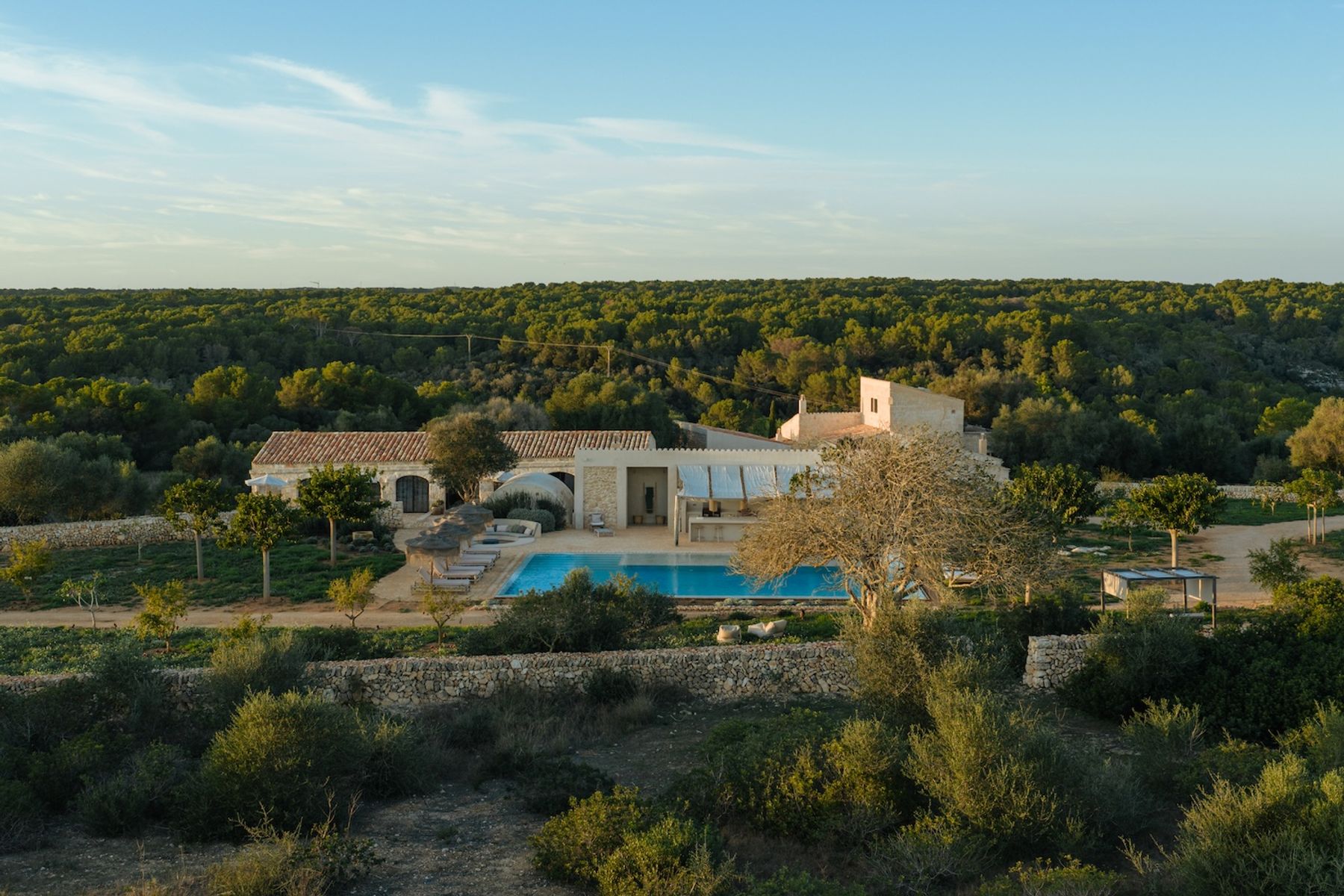
Our Menorca page lists one home, and it suits the island's rural character well. Santa Ana is a restored farmhouse set within a 210-hectare estate, made up of several farm buildings brought back to life. The main house, once the farmer's residence, holds a living room, library, dining room and kitchen, and a second suite sits in the former granary.
Outdoors, the listing features a swimming pool with a sun terrace, a fire pit, several lounge areas and an outdoor kitchen with a barbecue and dining space. A gym occupies the former stables, and geothermal heating and air conditioning keep the house comfortable through the seasons. Concierge support, daily housekeeping and a host are among the listed services, and daily breakfast can be arranged.
Santa Ana is the kind of luxury holiday villa that lets you live the island's farm rhythms from the inside, with the estate itself as the view.
Pairing Menorca With Mallorca
For a longer luxury villa holiday in Spain, Menorca pairs naturally with its larger neighbor. In Palma, the capital of Mallorca, Palacio de Miramar is an 18th-century mansion restored as a private residence, with views over the marina and the bay.
The listing features a gym, a home cinema, a library and a home office, along with several terraces and balconies. Concierge support and daily housekeeping are among the listed services, and daily breakfast can be arranged. Palma Airport is 9.1 kilometers away, according to our listing.
Splitting a stay between Santa Ana's countryside and Palacio de Miramar's city setting gives you two very different sides of the Balearics. Our team can arrange transfers and provisioning for both.
Frequently Asked Questions
What is special about Menorca?
Menorca is a UNESCO Biosphere Reserve across its whole territory, and its Talaiotic prehistoric sites became a World Heritage Site in 2023. It also has two contrasting coasts and two historic towns, Mahón and Ciutadella.
What is the capital of Menorca?
Mahón, also called Maó, is the capital, set above a deep natural harbor on the east coast. Ciutadella in the west was the capital before it and keeps a historic old town.
Do you have villas in Menorca?
Our Menorca page lists one home, Santa Ana, a restored farmhouse on a large rural estate. For a combined trip, Palacio de Miramar in Palma, Mallorca, offers a city setting on the neighboring island.
Planning Your Menorca Stay
The most useful things to know about Menorca are that it's protected, prehistoric and agricultural at heart, with two coasts and two towns that reward slow exploration. Paired with a home that reflects that character, it makes for a Mediterranean island stay with real depth.
Explore Menorca and our wider collection of luxury villas in Spain, and when you're ready, we're here.

Our Destinations


